The learning study
From analysis to a clear result.
This fictional randomized parallel-group study compared final knowledge-test scores after active practice or rereading, with the same assumed learning material and study time. All 80 synthetic participants contributed one score; there were no missing values or exclusions. Active practice had a higher mean score (n = 40, M = 67.47, SD = 10.19) than rereading (n = 40, M = 61.83, SD = 11.30).
The planned two-sided Welch t-test estimated a practice-minus-rereading difference of 5.65 score points, 95% CI [0.86, 10.44], t(77.19) = 2.35, p = .021. Cohen's d was 0.53, calculated as the mean difference divided by the pooled sample SD. The confidence interval above describes the unstandardized mean difference; no interval for d was calculated.
The simulated design supplies the independence assumption. Distribution summaries and the boxplot show substantial within-group variation and overlap. Neither group's values were flagged by the descriptive 1.5-IQR rule. The Shapiro–Wilk screens did not detect departures from normality; this does not establish normality or independence. Welch was selected in advance, without a preliminary-test rule.
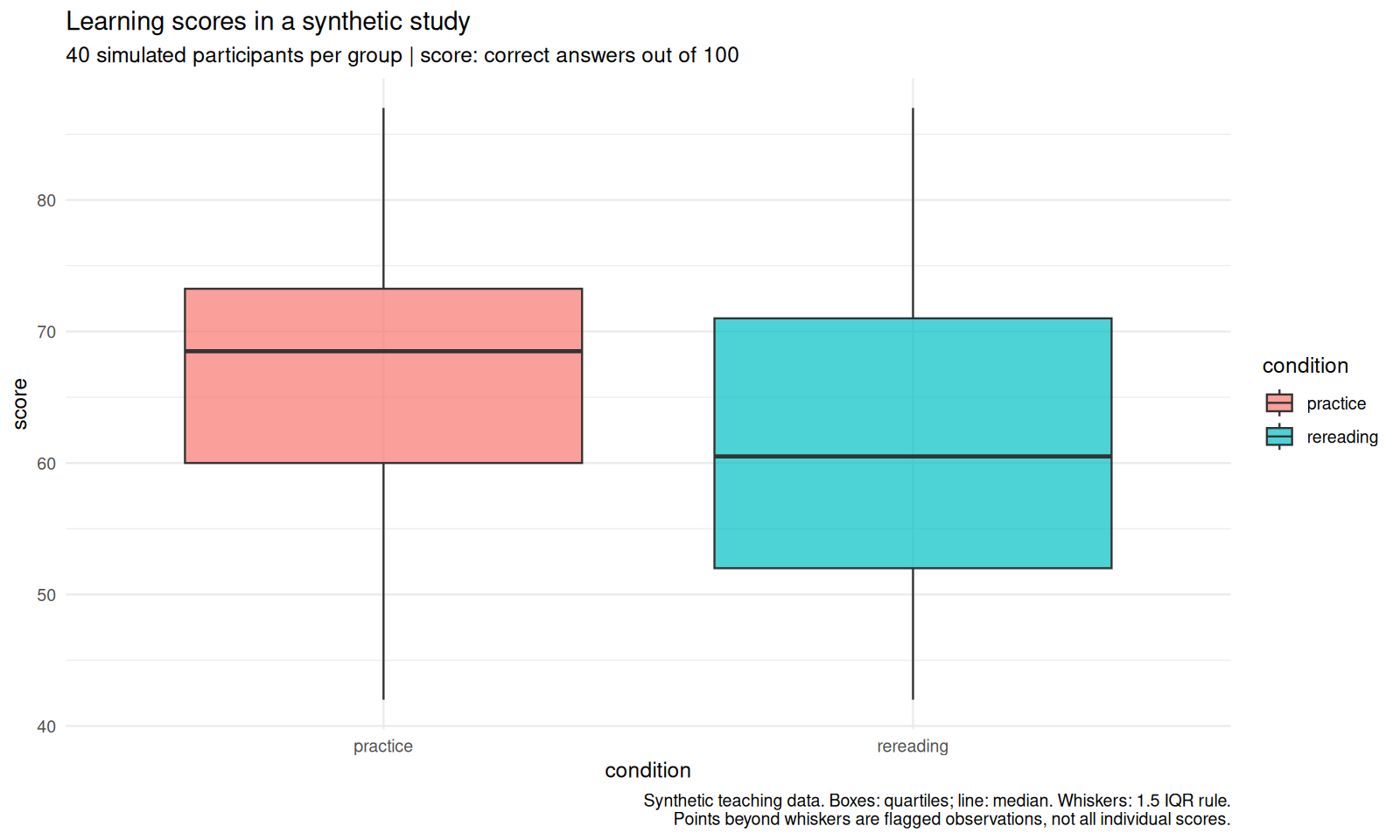
Under the analysis assumptions, the estimated difference is positive but imprecise: its interval spans roughly one to ten score points. No threshold for educational importance was specified, so neither the p-value nor d establishes practical value. A group-level difference also does not imply that every learner benefits. Most importantly, these scores were generated from assumed parameters; they are no empirical evidence that active practice outperforms rereading in real learners.
Source context: study sheet. Calculated evidence: descriptives, diagnostics, Welch result, saved analysis request, and automatic protocol. NLSS 2.0.1 / R 4.5.2. Reported means follow the protocol's two-decimal display; calculations use unrounded values. Teaching material 1.0. © 2026 Mike Hammes / NLSS, CC BY 4.0.